0. Intro / はじめに
VIETNAM'S SOCIO-ECONOMIC DEVELOPMENT No.1, SPRING 1995
REFORM OF PUBLIC FINANCE IN VIETNAM
Dang Duc Dam
Central Institute for Economic Management
In Vietnam's economic reforms in the past decade, the reform
of the system of public finance has been a central focus. The
achievements are quite obvious but newly arising problems are no few
either. We have no ambition to present in this paper a comprehensive
evaluation of the reform process in the macroeconomic field (which
seems a matter of similar importance and complexity) but we have only
concentrated our efforts on making a careful analysis of a number of
crucial basic problems in the system of public finance.
VIETNAM'S SOCIO-ECONOMIC DEVELOPMENT No.1, SPRING 1995
ベトナムにおける公共財政改革
Dang Duc Dam
中央経済管理研究所
過去10年間のベトナムの経済改革において、公共財政制度の改革は中心的な焦点であった。
達成された成果は極めて明白であるが、新たに生じている問題も少なくない。
本稿では、マクロ経済分野における改革過程の包括的評価を提示する野心はない(それは同様に重要かつ複雑な問題であるように思われる)。
我々はただ、公共財政制度における重要な基本問題のいくつかについて、注意深い分析を行うことに集中した。
1. 税制の策定と改革 / 1. ON THE ELABORATION AND REFORM OF TAXATION
Vietnam's fiscal policy in recent years was focussed on the
elaboration and putting into practice of a system of unified taxation
covering all economic sectors without exception, including the state
economic sector, which in the former mechanism had to contribute to
the state budget in the form of deduction from their returns.
Since early 1989, when most prices had been freed from a prefixation
by state authorities, state-owned enterprises have enjoyed extensive
rights in their business operation; the state budget no longer relied
mainly on state-owned enterprises contributions as in the past, so
the reform of the overall system of taxation became an urgent
requirement. On August 8th, 1990, the State Council promulgated three
laws on taxation: the Law on Turnover Tax; the Law on Profit Tax and
the Law on Special Consumption Commodities Tax. They are applicable
to all economic sectors. Together with the Law on Export-Import
Taxes, which was promulgated on December 29, 1987 and the legislation
concerning the adjustment of agricultural tax (issued on January 30,
1989), the above-mentioned laws on taxation have created a unified
legal framework for all the sources of state budgetary receipts. The
National Assembly of Vietnam has since then passed in review the
execution of these laws, examined and amended relevant provisions to
make them more suitable to the requirements and tasks for
socio-economic development. In July 1993, the Law on Agricultural
Land Use Tax was enforced which would bring more efficiency to the
legal framework of taxation.
Vietnam's tax system basically is now a modern one corresponding
fully to a market economy. It is because of that and increases in the
income source from the oil and gas industry that revenue to the state
budget has been considerably on the rise throughout the period of
implementation of the socio-economic stabilization program 1989-1993.
In 1993 alone, the amount of collected taxes made up 15.8 percent of
GDP.
Table 1: Structure of state budget revenue (% of GDP)
| 1990 | 1991 | 1992 | 1993 | 1994 | |
| Total budget revenue | 14.7 | 13.5 | 19 | 22.3 | 25.4 |
| Taxes collected from state enterprises | 8.7 | 7.7 | 10.3 | 11.5 | 12.3 |
| Taxes collected from non-state sectors | 2.3 | 2.6 | 3.5 | 4.1 | ... |
| Export-Import tax | 1.8 | 1.4 | 2 | 4.3 | ... |
| Non-tax receipts | 2 | 1.8 | 3.3 | 2.5 | 1.5 |
Source: Ministry of Finance 1994.
Yet according to general assessment, the current tax system of
Vietnam is still very complex with too many tax rates and large
differences between them. For instance, the turnover tax which is an
extremely important tax category, has up to 16 different rates
ranging from 0 to 40 percent levied on turn-out. It is also obvious
that taxes overlap one another. For instance, a food processing
enterprise may have to pay 2 percent of turnover tax for its sales of
ice, 4 percent for milk, 8 percent for coffee etc. That complicates
the accounting system as well as the tax collecting system. The tax
system is too complex and the procedure for asserting tax rates and
collecting taxes are still irrational and in disagreement with each
other to say nothing of the inefficiency of tax collectors, which
causes loss to revenue gathering.
Several foreign financial experts hold the view that many tax rates
applied in Vietnam at present are too high, first and foremost in
comparison with the efficiency of the tax collecting apparatus.
According to the Laffer curve, if the tax rates reach a certain
marginal level, the total of collected taxes could not continue
increasing in direct proportion with the tax rates, and even somewhat
decrease, because the higher the tax rates, the more the people seek
by every means and way to evade paying taxes. The weaker the capacity
of the tax collecting apparatus, the lower the marginal point of the
Laffer curve. So when the tax rates are not yet high enough, the
loss of revenue is already very big. This situation perfectly
corresponds with the circumstances prevailing just now in Vietnam,
especially within the non-state sectors. This explains the phenomenon
of why the amount of taxes collected from state-owned enterprises has
almost trebled those collected from non-state sectors, while more
than one half of GDP has been created by the later.
The tax policy is not only duty-bound to create a source of revenue
to the state budget but still assumes an important function of
encouraging production and regulating consumption. Nearly all the
developed countries have applied investment incentive policies with
regard to their businesses by means of reduction of profit tax. The
profit tax rates in Vietnam actually range from 30 to 50 percent.
Those enterprises operating with foreign invested capital according
to the Law on Foreign Investment would benefit from a preferential
treatment in taxation ranging only from 15 to 20 percent; i.e. equal
to only 40-50 percent of the profit tax rates applied to domestic
enterprises.
In principle, the above preferential treatment in profit tax has a
definite effect on the attraction of foreign investment, but it has
given rise to irrationalities and led to an unequal competition to
the disadvantage of domestic enterprises. At the present time, no big
effect is observed yet from this preferential treatment, but the
pressure exerted on domestic enterprises will gradually increase when
the state subsidy system is strictly eradicated and foreign investment
will make up a considerable proportion in the total invested capital.
Under those circumstances, a tax system with too much difference in
tax rates between enterprises with foreign invested capital and
domestic capital would not only damage the source of budget revenue,
but also hinder the objective of using foreign capital for giving a
boost to domestic production. On the other hand, that way of doing
things would create opportunities for foreign investors to introduce
into Vietnam outdated machinery, equipment and backward technologies,
and would still gain the same profit.
Along with the reforms of tax categories, the apparatus designed to
manage and collect taxes in the past period of time has been
reorganized to make it more efficient from central to local levels.
This must be consistently carried on as it creates for the government
the necessary conditions to efficiently manage nearly all the sources
of revenue and to regulate on time its expenditures throughout the
country, thereby ensuring a balanced development between different
regions, especially redistributing adequate financial resources to
the poor provinces. For that reason, more concentration on tax
collection and a stricter managerial procedure of sources of revenue
may be a required standard in the reform of the public finance
system.
近年のベトナムの財政政策は、国家経済部門を含むすべての経済部門を例外なくカバーする統一税制の策定と実施に焦点を当てていた。
従来のメカニズムでは、国家経済部門は収益からの控除という形で国家予算に貢献しなければならなかった。
1989年初頭以降、ほとんどの価格が国家当局による事前固定から解放されると、国有企業は事業運営において広範な権利を享受するようになった。
国家予算はもはや、かつてのように主として国有企業の拠出に依存することはなくなり、税制全体の改革が緊急の要請となった。
1990年8月8日、国家評議会は税制に関する3つの法律、すなわち売上税法、利益税法、特別消費財税法を公布した。
これらはすべての経済部門に適用される。
1987年12月29日に公布された輸出入税法、および1989年1月30日に発出された農業税調整に関する法令とともに、
上記の税制法は国家予算歳入のすべての源泉に対する統一的な法的枠組みを創出した。
ベトナム国会はその後、これらの法律の執行を審査し、社会経済発展の要請と任務により適合させるために関連条項を検討・修正してきた。
1993年7月には、農業用地使用税法が施行され、税制の法的枠組みにより高い効率性がもたらされることとなった。
ベトナムの税制は、現在では基本的に市場経済に完全に対応した近代的なものとなっている。
それと石油・ガス産業からの収入源の増加により、1989~1993年の社会経済安定化プログラム実施期間を通じて、
国家予算への歳入は著しく増加してきた。
1993年だけでも、徴収された税の総額はGDPの15.8%を占めた。
表1:国家予算歳入の構造(GDPに対する%)
| 1990 | 1991 | 1992 | 1993 | 1994 | |
| 予算総歳入 | 14.7 | 13.5 | 19 | 22.3 | 25.4 |
| 国有企業からの徴税 | 8.7 | 7.7 | 10.3 | 11.5 | 12.3 |
| 非国有部門からの徴税 | 2.3 | 2.6 | 3.5 | 4.1 | ... |
| 輸出入税 | 1.8 | 1.4 | 2 | 4.3 | ... |
| 税外収入 | 2 | 1.8 | 3.3 | 2.5 | 1.5 |
出所:財務省 1994年。
しかし一般的評価によれば、現在のベトナムの税制は依然として非常に複雑であり、税率が多すぎ、それらの間の格差も大きい。
たとえば、極めて重要な税目である売上税は、0~40%の範囲で最大16種類の異なる税率を売上に対して課している。
また、税が相互に重複していることも明らかである。
たとえば、食品加工企業は氷の販売に対して売上税2%、牛乳に対して4%、コーヒーに対して8%などを支払わなければならない場合がある。
これは会計制度および徴税制度を複雑化させる。
税制は過度に複雑であり、税率の決定と徴税の手続きは依然として不合理で相互に矛盾しており、
徴税職員の非効率性は言うまでもなく、歳入収集に損失をもたらしている。
多くの外国の財政専門家は、現在ベトナムで適用されている多くの税率が、とりわけ徴税機構の効率性と比較して高すぎると見ている。
ラッファー曲線によれば、税率がある限界水準に達すると、徴収される税の総額は税率に直接比例して増加し続けることができず、
むしろいくらか減少する。なぜなら、税率が高いほど、人々はあらゆる手段と方法で納税を回避しようとするからである。
徴税機構の能力が弱いほど、ラッファー曲線の限界点は低くなる。
したがって、税率がまだ十分に高くなくても、歳入の損失はすでに非常に大きい。
この状況は、とくに非国有部門において、現在ベトナムで支配的な状況と完全に一致している。
これは、国有企業から徴収される税額が非国有部門から徴収される税額のほぼ3倍であるのに対し、
GDPの半分以上は後者によって創出されているという現象を説明している。
税制政策は、国家予算の歳入源を創出する義務を負うだけでなく、生産を奨励し消費を規制するという重要な機能も担っている。
ほぼすべての先進国は、利益税の軽減により企業に対する投資奨励政策を適用してきた。
ベトナムの利益税率は実際には30~50%の範囲である。
外国投資法に基づいて外国投資資本で運営される企業は、わずか15~20%の範囲の税制優遇措置から利益を得る。
すなわち、国内企業に適用される利益税率のわずか40~50%に相当する。
原則として、利益税における上記の優遇措置は外国投資の誘致に一定の効果を持つが、
それは不合理性を生じさせ、国内企業に不利な不平等競争を招いている。
現時点では、この優遇措置からまだ大きな効果は観察されていないが、
国家補助制度が厳格に根絶され、外国投資が総投資資本のかなりの割合を占めるようになれば、
国内企業に及ぼされる圧力は徐々に増大するであろう。
そのような状況下では、外国投資資本を持つ企業と国内資本企業との間で税率に大きな差がある税制は、
予算歳入の源泉を損なうだけでなく、外国資本を利用して国内生産に弾みをつけるという目的をも妨げることになる。
他方、そのようなやり方は、外国投資家がベトナムに時代遅れの機械、設備、後進的な技術を導入する機会を創出し、
それでも同じ利益を得ることになる。
税目の改革とともに、過去の期間において税の管理・徴収のために設計された機構は、
中央から地方レベルまでより効率的になるよう再編されてきた。
これは、政府が歳入のほぼすべての源泉を効率的に管理し、全国にわたってその支出を適時に規制するために必要な条件を創出するので、
一貫して継続されなければならない。
それにより、異なる地域間のバランスのとれた発展が確保され、とくに貧困省への適切な財政資源の再配分が行われる。
そうした理由から、徴税への集中強化と歳入源のより厳格な管理手続きが、
公共財政制度の改革における要求される基準となり得る。
2. 貯蓄と投資 / 2. SAVINGS AND INVESTMENT IN THE PUBLIC FINANCE SYSTEM
A prime importance of Vietnam's economy is to obtain a high growth
rate, and this can be done only by the instrumentality of savings and
investment. The amount of savings has risen considerably in past
years, from 3.2 percent of GDP in 1985 to 16.3 percent in 1992 (see
diagram 1).
Diagram 1: Savings and investment in 1990-1994
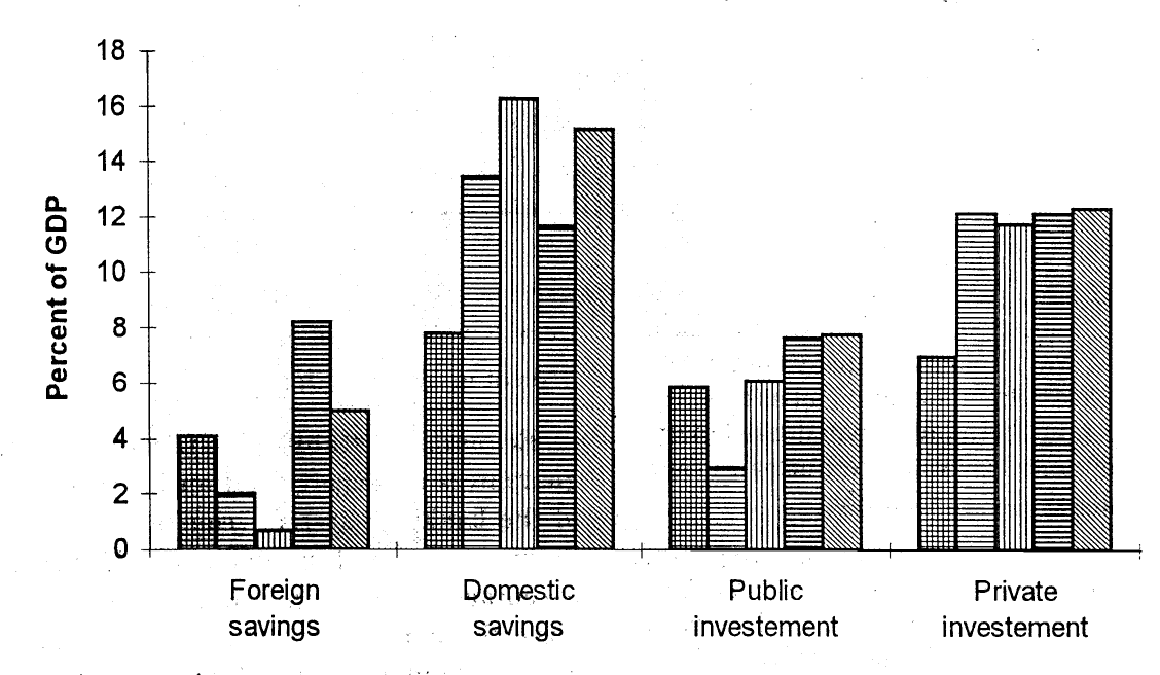
From left: 1990, 1991, 1992, 1993, 1994
Source: World Bank - September 1994
Economic stability, firmer legal guarantees of property and
an improvement of the banking system constitute factors to encourage
savings and to for the use in business and production. However,
domestic savings were down at the beginning of 1993, standing at only
11.2 percent of GDP. The main cause of this proportional decrease was
the sudden rise of foreign invested capital. This was an unhealthy
manifestation, especially when the source of foreign capital proved
to be not sure enough, as shown in 1993 which found expression in the
bad effects on the process of investment and seriously affected
economic growth. We must strive our best to raise the level of
domestic savings to about 15 percent in this current year. Along with
a change in terms of saving, the investment activities in the
national economy also recorded a high growth rate. As compared to
1992, the year 1993 showed an increase by 41 percent, calculated
according to current prices and by 32 percent, calculated according
to fixed prices. According to adjusted data from the General
Statistical Office, the rate of investments compared to GDP in 1991
was 15.1 percent; in 1992 this rate rose to 17 percent and in 1993 to
19.4 percent.
Based on statistical data, Vietnam's ICOR coefficient was low,
standing at only 2.2 percent in 1993. It was far lower compared to
other developing countries whose respective ICOR coefficients were
generally 3-4 percent.
Table 2: Investment, growth rate and ICOR of several Asian countries in the 1970s and 1980s
| Country | Investment/GDP (percent) |
Growth rate of GDP (percent) |
ICOR | |||
| 1970s | 1980s | 1970s | 1980s | 1970s | 1980s | |
| China | 30.2 | 35.7 | 5.9 | 9 | 5.1 | 4 |
| India | 20.1 | 23.3 | 3.1 | 5.8 | 6.5 | 4 |
| Indonesia | 22.7 | 30.3 | 7.2 | 5.6 | 3.2 | 5.4 |
| S.Korea | 28 | 30.5 | 8.7 | 9.3 | 3.2 | 3.3 |
| Philippines | 27.8 | 21.9 | 5.9 | 1.7 | 4.7 | 12.9 |
| Thailand | 25.9 | 26.8 | 6.7 | 7.9 | 3.9 | 3.4 |
| Taiwan | 29.6 | 23.7 | 10 | 8 | 3 | 3 |
Source: "In the direction of flying dragons". Harvard International Development Institute.
World Bank officials put forward three reasons for explaining
Vietnam's low ICOR coefficient. First, it is due to many big
investment projects which were put into operation from the preceding
decade (hydro-electric power, oil and gas, and cement) and are now
operating at full capacity. Second, it is due to the impact of the
removal of the restrictions imposed by the previous mechanism which
brought into full play a potentials that didn't need many additional
investments. Third, it is due to the existence of many labour
intensive and not capital intensive production establishments which
have given rise to economic growth in the past years.
The total invested capital of the economy comprises two parts:
investments made by the public financial sector and those derived
from non-state economic establishments. The state has made only few
investments in recent years as it has had to take up situational
measures in order to counter inflation and realize socio-economic
stabilization. Many cut-backs in investment were made by the state,
particularly in social services such as education and public health.
These were regarded as investments in the development of human
capital which is needed for future growth. There is good ground for
anxiety when cut-backs in education must be made. The percentage of
public spending on education in Vietnam is about 1.5 percent of GDP
which is said to be at a too low level compared with other Southeast
Asian countries. The advantage of Vietnam's relatively high level of
education is tending to be eroded.
Vietnam's primary education school pupils as a percentage of the
total of school-age children has been reduced from 98 percent in
1986-1987 to only 87 percent in 1991-1992. And Vietnam's secondary
general education schools, pupil numbers were reduced from 13 percent
to 7 percent in the same period of time. This reflects to some extent
the decline of education.
One more thing which deserves our attention is the degree of
effectiveness and the orientation for big projects of state
investment. Some people have thought it would be preferable to use
the available capital to invest in small-scale projects which would
yield quicker returns through which economic growth rates could be
secured. In their opinion, large investment projects are most
desirable, but it would be too early for Vietnam to carry them into
effect in the immediate future. The reason is that Vietnam has few
experiences in this matter and lacks both possibility and capacity
for examining and verifying socio-economic effectiveness of such
investment projects before their approval. For that reason, Vietnam
will run the risk of non-profitability and lack of funds. If such a
weakness were not to be overcome in the future, state investments
would not bring back the required results, but still cause a
curtailment of private investment, thereby reducing to a great extent
the economic growth rate.
In recent years, investments of the public sector derived from the
state budget have been gradually restored, and recorded a
considerable increase from a very low level of 2.8 percent of GDP in
1991 to nearly 7 percent of GDP in 1993. State investments at present
are focussed mainly on the development of the economic and social
infrastructure. In the long run, private investment will play a
fundamental role in the growth of the market economy. But under
Vietnam's prevailing circumstance in the years ahead, private
entrepreneurs are not yet ready to make sufficient investment in
different undertakings owing to an investment environment unstable
and not favourable to them. That is why willy-nilly, the state must
play the role of a "midwife" for economic growth, no matter that it
is still lacking in knowledge and experience in business
undertakings.
Together with concentrated investment in the building and development
of the infrastructure, the state must select a number of key
enterprises with strong profitability prospects for making
investments in. By so doing, the state will aim at building large
scale businesses with great diversification in products and trade,
thereby turning them into economic corporations of national and
international importance. Such businesses will serve as pillars of
our economy in its industrialization and international
competition.
The practice of industrialization in newly industrialized countries,
for instance in the Republic of Korea, shows that the businesses,
large in scale and diversified in trades and products, constitute one
of the four basic factors for the success of industrialization in the
present epoch. It is the large scale and great diversification that
have helped these businesses get in touch with all groups of
consumers in society and overcome economic crises. Those large
businesses are the very centre of scientific and technological
advances, for market research and technological renewal. At the
initial stage of industrialization, the state is called upon to set
up and develop such businesses.
The existence and activity of economic corporations as such in
Eastern Asia, especially in the Republic of Korea, have not only
given a strong impetus to the process of industrialization but also
have helped eliminate excessive monopolization, thereby raising the
effectiveness of the whole economy. On the contrary, such large scale
businesses operating in many other countries, for instance in Brazil,
India and Chile have created for the monopolists the conditions to
gain control of too large a proportion of the supply of goods and
services in home markets and have become one of the structural
impediments to continued industrialization and economic development.
The conclusion which may be drawn here is that in order to bring
large-scale businesses into full play in an active role in the
economic growth, the state must elaborate a determined regime and a
clear legal framework for their operation. It must have a contingent
of officials with moral qualities and professional skills to assume
control and supervision of the activities of large-scale businesses
by orientating the latter to the accomplishment of the set targets in
the strategy of national development.
ベトナム経済にとって最も重要なことは高い成長率を達成することであり、これは貯蓄と投資の手段によってのみ実現できる。
貯蓄額は過去数年間で大幅に増加し、1985年のGDPの3.2%から1992年には16.3%に達した(図1参照)。
図1:1990~1994年の貯蓄と投資
左から:1990年、1991年、1992年、1993年、1994年
出所:世界銀行 1994年9月
経済の安定、財産のより確実な法的保証、銀行制度の改善は、貯蓄を奨励し事業と生産に利用するための要因となる。
しかし、国内貯蓄は1993年初頭に減少し、GDPのわずか11.2%にとどまった。
この比率低下の主な原因は、外国投資資本の急増であった。
これは不健全な兆候であり、とくに外国資本の源泉が十分に確実でないことが判明した場合、
1993年に示されたように投資過程に悪影響を及ぼし、経済成長に深刻な影響を与えた。
今年度中に国内貯蓄の水準を約15%まで引き上げるよう最善を尽くさねばならない。
貯蓄面での変化とともに、国民経済における投資活動も高い成長率を記録した。
1992年と比較して、1993年は経常価格で計算して41%、固定価格で計算して32%の増加を示した。
統計総局の調整データによれば、GDPに対する投資率は1991年が15.1%、1992年は17%、1993年は19.4%に上昇した。
統計データに基づくと、ベトナムのICOR係数は低く、1993年にはわずか2.2%にとどまった。
これは、ICOR係数が一般に3~4%である他の途上国と比べてはるかに低い。
表2:1970年代および1980年代におけるアジア数か国の投資、成長率、ICOR
| 国 | 投資/GDP (%) |
GDP成長率 (%) |
ICOR | |||
| 1970年代 | 1980年代 | 1970年代 | 1980年代 | 1970年代 | 1980年代 | |
| 中国 | 30.2 | 35.7 | 5.9 | 9 | 5.1 | 4 |
| インド | 20.1 | 23.3 | 3.1 | 5.8 | 6.5 | 4 |
| インドネシア | 22.7 | 30.3 | 7.2 | 5.6 | 3.2 | 5.4 |
| 韓国 | 28 | 30.5 | 8.7 | 9.3 | 3.2 | 3.3 |
| フィリピン | 27.8 | 21.9 | 5.9 | 1.7 | 4.7 | 12.9 |
| タイ | 25.9 | 26.8 | 6.7 | 7.9 | 3.9 | 3.4 |
| 台湾 | 29.6 | 23.7 | 10 | 8 | 3 | 3 |
出所:「飛翔する竜の方向へ」ハーバード国際開発研究所。
世界銀行職員は、ベトナムの低いICOR係数を説明する3つの理由を提示している。
第一に、過去10年間に稼働した多くの大型投資プロジェクト(水力発電、石油・ガス、セメント)が現在フル稼働していることによる。
第二に、以前のメカニズムによる制約の撤廃の影響により、多くの追加投資を必要としない潜在力が十分に発揮されたことによる。
第三に、過去数年間の経済成長をもたらした多くの労働集約的で資本集約的でない生産施設の存在による。
経済の総投資資本は2つの部分から成る。すなわち、公共財政部門による投資と、非国有経済機関に由来する投資である。
国家は近年、インフレに対抗し社会経済の安定化を実現するために状況的措置を講じなければならなかったため、わずかな投資しか行っていない。
国家による多くの投資削減が行われ、とくに教育や公衆衛生などの社会サービスにおいてそうであった。
これらは将来の成長に必要な人的資本の開発への投資と見なされていた。
教育への削減を行わねばならない場合、懸念する十分な理由がある。
ベトナムの教育への公的支出の割合はGDPの約1.5%であり、これは他の東南アジア諸国と比較して低すぎる水準にあると言われている。
ベトナムの比較的高い教育水準という優位性は、侵食される傾向にある。
就学年齢児童総数に対するベトナムの初等教育学校児童の割合は、1986~1987年の98%から1991~1992年にはわずか87%に減少した。
そしてベトナムの中等一般教育学校では、同じ期間に生徒数が13%から7%に減少した。
これはある程度、教育の衰退を反映している。
我々の注意に値するもう一つの事柄は、国家投資の大型プロジェクトに対する効率性の程度と方向付けである。
一部の人々は、利用可能な資本を小規模プロジェクトへの投資に使用する方が望ましいと考えている。
そうすれば、経済成長率を確保できるより速い収益が得られるからである。
彼らの意見では、大規模投資プロジェクトは最も望ましいが、ベトナムが直近の将来にそれらを実行に移すには時期尚早である。
その理由は、ベトナムはこの問題についての経験がほとんどなく、
そうした投資プロジェクトの承認前にその社会経済的有効性を検証・確認する可能性も能力も欠いているからである。
そのため、ベトナムは不採算と資金不足のリスクを負うことになる。
もしそのような弱点が将来克服されなければ、国家投資は必要な成果をもたらさず、
かえって民間投資の削減を引き起こし、それによって経済成長率を大幅に低下させることになる。
近年、国家予算に由来する公共部門の投資は徐々に回復し、1991年のGDPの2.8%という非常に低い水準から、
1993年にはGDPの約7%へと大幅な増加を記録した。
現在の国家投資は主として経済・社会インフラの開発に集中している。
長期的には、民間投資が市場経済の成長において基本的な役割を果たすであろう。
しかし今後数年間のベトナムの支配的な状況下では、民間起業家は、
不安定で彼らに有利でない投資環境のために、異なる事業に十分な投資をする準備がまだできていない。
そのため、国家はやむを得ず、事業活動における知識と経験が依然として不足しているにもかかわらず、
経済成長の「産婆役」を果たさねばならない。
インフラの建設と開発への集中投資とともに、国家は投資を行うために、
強い収益性見通しを持ついくつかの主要企業を選択しなければならない。
そうすることにより、国家は製品と貿易の大きな多様化を持つ大規模事業を構築し、
それによってそれらを国家的および国際的重要性を持つ経済法人に転換することを目指す。
そうした事業は、工業化と国際競争における我々の経済の柱として機能するであろう。
たとえば韓国などの新興工業国における工業化の実践は、規模が大きく取引と製品が多様化した企業が、
現代における工業化の成功のための4つの基本要因の一つを構成することを示している。
大規模と大きな多様化こそが、これらの企業が社会のあらゆる消費者グループと接触し、経済危機を克服するのを助けてきた。
それらの大企業は、科学技術の進歩、市場調査、技術革新のまさに中心である。
工業化の初期段階では、国家がそうした企業を設立し発展させるよう求められる。
東アジア、とくに韓国におけるそうした経済法人の存在と活動は、工業化プロセスに強い推進力を与えただけでなく、
過度な独占を排除し、それによって経済全体の有効性を高めるのにも役立った。
対照的に、たとえばブラジル、インド、チリなど他の多くの国で運営されているそうした大規模企業は、
独占者に対して国内市場における財・サービスの供給のあまりに大きな割合を支配する条件を創出し、
継続的な工業化と経済発展への構造的障害の一つとなってきた。
ここで引き出される結論は、大規模企業を経済成長において積極的な役割で十分に発揮させるためには、
国家はその運営のための確固たる体制と明確な法的枠組みを策定しなければならないということである。
国家は、大規模企業の活動を監督・管理し、国家発展戦略において設定された目標の達成に向けて後者を方向付けるために、
道徳的資質と専門技能を持つ職員の一団を持たねばならない。
3. 財政赤字とその補填 / 3. BUDGET DEFICIT AND ITS COMPENSATION
Vietnam's budget in the early 80s was characterized by a heavy
subsidization by the state in every field of activity. In the years
1982-1989, nearly one third of the total expenditures of the state
budget was reserved for financing subsidized items, especially for
giving pecuniary aid to keep prices at fixed levels according to a
system of rations.
The process of liberalizing prices has given rise to the reduction
and eventually to the elimination of the system of subsidization by
the state budget. In 1990, when nearly all the prices were set free
under the influence of the market mechanism, the state budget was no
longer responsible for subsidizing rationed foods and goods, for
providing direct financial aid to state-owned subsidized industries
as in former times but in indirect subsidization through loans with
low interest rates that still continued until recent times. In the
past decade, due to different motives, Vietnam has been continually
in a state of budget deficit. But it would be quite fair to say that
state budget deficits have been common place in nearly all countries
of the world, ranging from industrially developed to developing
countries. Yet Vietnam's budget deficit was rather high, and the
deficit has fluctuated in an unpredictable manner even when soaring
inflation was brought under control and the subsidy system was
basically ended (see table 3).
Table 3: State budget (percent of GDP)
| 1990 | 1991 | 1992 | 1993 | 1994 | |
| Total income | 14.7 | 13.5 | 19 | 22.3 | 25.4 |
| Total expenditure | 22.8 | 17.2 | 22.7 | 28.5 | 28.1 |
| Deficit | -8.1 | -3.7 | -3.7 | -6.2 | -2.7 |
Source: Ministry of Finance
A budget deficit is the result of the state of the total
income exceeding the total revenue from taxes and other supplementary
receipts of the state. But how does this occur? Is it true that all
budget deficits reflect under-development, or recession
under-development, or recession of the economy? What measures should
be taken to make up for budget deficits? These are problems which
must be seriously tackled in Vietnam now.
The conception of how there is a budget deficit greatly differs from
one person to another but it many be summed up in two basic
arguments.
One group advocates that a budget deficit is the result of a weak
economy. If there is an excess of expenditure over income, it would
lead to bankruptcy, unemployment and poverty. So the state is
duty-bound to have a tight control over its budget spending and make
it conform to the source of income. This conception of budget
equilibrium is very popular and constitutes a generally accepted
behaviour in the industrially developed countries.
Another group states that many countries do not abide by this law and
claim budget deficits have become a widespread phenomenon in the
world. State budget deficits exist, and how to deal with it are very
important to carry out the preset targets. According to World Bank
figures in the late 80s, state budget deficits became a widespread
phenomenon even in developed countries.
Samuelson and Nordhaus, co-authors of the book entitled "Economics",
divided the state budget deficit into two categories; business-cycle
deficit and structural deficit. Business-cycle deficit is a deficit
reflecting the state of economic decline. A growth rate slows down or
dwindles away, accompanied by a reduction of income earnings by both
businesses and the population at large which lead to the decrease in
tax collections while the needs of budget spending by the state are
usually growing in the period of economic recession such as payments
made by the state to unemployed people, to job creation and to social
welfare facilities.
Structural deficit reflects the restructuring of a state budget.
Spending with a view to realizing the objective of expanding
investment, structural deficit will have the effect of increasing the
"aggregate demand" and creating conditions for promoting investment,
raising production capacity and stepping up economic growth.
However, it is not valid that the deeper the structural deficit, the
more advantageous accrue for economic growth. This possibility is
definitely limited. That limit depends on the particular traits of
the economic situation in each country, and at the capacity of the
state to deal with its own budget deficit.
When the budget deficit is too big, the state must mobilize funds
from different sources for deficit compensation. In the 1986-1990
period the Vietnamese state budget deficit was compensated for mainly
by an increase in the supply of money in circulation, or otherwise
called the credit of the Central Bank (making up 61% of deficit
financing). In the meantime, loans and aids from foreign countries
had decreased 66% in the 1981-1985 period to only 36% in the
1986-1990 period. The source of money for deficit compensation
derived from credit loans in the country in this period was of little
value (only about 3%) (see table 4)
Table 4: Structure of the source of state budget deficit compensation in the 1981-1994 period (percent of budget deficit)
| 1981-85 | 1986-90 | 1991 | 1992 | 1993 | 1994 | |
| Money issue | 30.6 | 57.9 | 10 | - | - | - |
| Borrowing | ||||||
| from abroad | 65.7 | 38.5 | 25 | 52 | 71 | 60 |
| from domestic | 3.7 | 3.7 | 65 | 48 | 29 | 40 |
Source: Ministry of Finance.
The structure of compensating for the over-expenditure of the
state budget has undergone a fundamental change since 1991. Worthy of
note was the issue of bank notes for deficit financing was limited to
a minimum in 1991 and completely ended by 1992. This was a
considerable contribution to the monetary-financial policy of market
prices, to the control of inflation in particular and to
socio-economic stabilization in general. But as the budget deficit
was tending to always increase, the State has been obliged to borrow
funds from inside the country and from abroad to cover budgetary
over-expenditure.
Borrowing money from the population to finance the state budget
deficit is much better than issuing banknotes. But it also naturally
brings about some negative aspects. For that reason, borrowing money
from the population cannot be used without limits. On the one hand,
borrowing money for budget spending this year will be a financial
burden for coming years, especially borrowing on high interest as it
is now (about 2% per month). On the other hand, the source of capital
investment of the country depends largely on the economized funds of
the economy. If the state uses those economized funds in the form of
borrowing money from the population to finance a budget deficit, the
non-state sectors will have less and less capital for investment in
their business undertakings for production development. The problem
needing to be solved here is how to define the exact limits between
investments from the state and those from non-state sectors in order
to secure a rational distribution and use of the limited economized
funds of Vietnam's national economy.
※日本語訳:日本・ベトナム交流促進センターにて ChatGPT 5.2, Gemini 3, Cursor 2.4.32 を使用
1980年代初頭のベトナムの予算は、あらゆる活動分野において国家による重い補助金支給を特徴としていた。
1982~1989年には、国家予算の総支出のほぼ3分の1が補助項目の資金調達のために留保され、
とくに配給制度に基づいて価格を固定水準に保つための金銭的援助のために用いられた。
価格自由化のプロセスは、国家予算による補助金制度の削減、そして最終的には廃止をもたらした。
1990年、市場メカニズムの影響下でほぼすべての価格が自由化されると、
国家予算はもはや配給食料・物資の補助金支給や、かつてのように国有補助産業への直接的な財政援助の責任を負わなくなったが、
低金利融資による間接的補助金は最近まで続いていた。
過去10年間、異なる動機により、ベトナムは継続的に財政赤字の状態にあった。
しかし、国家予算赤字は、工業先進国から途上国に至るまで、世界のほぼすべての国で一般的であると言うことは全く公正である。
それでもベトナムの財政赤字はかなり高く、急騰するインフレが抑制され補助金制度が基本的に終了した後でさえ、
赤字は予測不可能な方法で変動してきた(表3参照)。
表3:国家予算(GDPに対する%)
| 1990 | 1991 | 1992 | 1993 | 1994 | |
| 総収入 | 14.7 | 13.5 | 19 | 22.3 | 25.4 |
| 総支出 | 22.8 | 17.2 | 22.7 | 28.5 | 28.1 |
| 赤字 | -8.1 | -3.7 | -3.7 | -6.2 | -2.7 |
出所:財務省
財政赤字は、総支出が税および国家の他の補足的収入からの総歳入を超過している状態の結果である。
しかしこれはどのようにして起こるのか?
すべての財政赤字が低開発、あるいは景気後退、あるいは経済の衰退を反映しているというのは本当か?
財政赤字を補填するためにどのような措置を講じるべきか?
これらは現在ベトナムで真剣に取り組まねばならない問題である。
財政赤字がどのように存在するかという概念は人によって大きく異なるが、2つの基本的議論にまとめることができる。
一つのグループは、財政赤字は脆弱な経済の結果であると主張する。
もし支出が収入を超過すれば、それは破産、失業、貧困につながる。
したがって国家は予算支出を厳しく管理し、それを収入源に適合させる義務を負う。
この予算均衡の概念は非常に人気があり、工業先進国において一般に受け入れられている行動を構成している。
もう一つのグループは、多くの国がこの法則に従わないと述べ、財政赤字は世界で広範な現象になっていると主張する。
国家予算赤字は存在し、それにどう対処するかが、設定された目標を達成するために非常に重要である。
世界銀行の1980年代後半の数値によれば、国家予算赤字は先進国においてさえ広範な現象となった。
「経済学」という書名の本の共著者であるサミュエルソンとノードハウスは、国家予算赤字を2つのカテゴリーに分類した。
すなわち、景気循環的赤字と構造的赤字である。
景気循環的赤字は、経済衰退の状態を反映する赤字である。
成長率が減速または消失し、企業と国民全体の所得収入の減少を伴い、それが徴税の減少につながる一方で、
国家による予算支出の必要性は、失業者への支払い、雇用創出、社会福祉施設など、経済不況期には通常増大する。
構造的赤字は、国家予算の再構築を反映している。
投資拡大の目的を実現するための支出を伴う構造的赤字は、「総需要」を増加させる効果を持ち、
投資促進、生産能力向上、経済成長加速のための条件を創出する。
しかし、構造的赤字が深いほど経済成長にとってより有利になるというのは妥当ではない。
この可能性は明確に限定されている。
その限界は、各国の経済状況の特定の特性、および国家が自国の財政赤字に対処する能力に依存する。
財政赤字があまりに大きい場合、国家は赤字補填のために異なる源泉から資金を動員しなければならない。
1986~1990年期において、ベトナムの国家予算赤字は主として流通貨幣供給の増加、
すなわち中央銀行の信用(赤字資金調達の61%を占める)によって補填された。
一方、外国からの融資と援助は、1981~1985年期の66%から1986~1990年期にはわずか36%に減少した。
この期間における国内の信用融資に由来する赤字補填のための資金源は、ほとんど価値がなかった(わずか約3%)(表4参照)。
表4:1981~1994年期における国家予算赤字補填源の構造(予算赤字に対する%)
| 1981~85 | 1986~90 | 1991 | 1992 | 1993 | 1994 | |
| 通貨発行 | 30.6 | 57.9 | 10 | - | - | - |
| 借入 | ||||||
| 海外から | 65.7 | 38.5 | 25 | 52 | 71 | 60 |
| 国内から | 3.7 | 3.7 | 65 | 48 | 29 | 40 |
出所:財務省。
国家予算の過剰支出を補填する構造は、1991年以降、根本的な変化を遂げた。
注目に値したのは、赤字資金調達のための紙幣発行が1991年に最小限に制限され、1992年までに完全に終了したことである。
これは市場価格の金融・財政政策、とくにインフレ抑制、そして一般に社会経済安定化へのかなりの貢献であった。
しかし財政赤字が常に増加する傾向にあったため、国家は予算の過剰支出を補填するため、
国内および海外から資金を借り入れることを余儀なくされてきた。
国家予算赤字を資金調達するために国民から資金を借り入れることは、紙幣を発行するよりはるかに良い。
しかしそれはまた当然ながら、いくつかの否定的側面をもたらす。
そのため、国民からの借入は制限なく利用することはできない。
一方では、今年度の予算支出のために資金を借り入れることは、今後数年間の財政負担となる。
とくに現在のように高金利(月約2%)で借り入れることはそうである。
他方、国の資本投資の源泉は、経済の節約された資金に大きく依存している。
もし国家が財政赤字を資金調達するために、国民から資金を借り入れる形でそれらの節約された資金を使用すれば、
非国有部門は生産発展のための事業活動への投資資本がますます少なくなる。
ここで解決される必要がある問題は、ベトナム国民経済の限られた節約資金の合理的な配分と利用を確保するために、
国家からの投資と非国有部門からの投資との間の正確な限界をどのように定義するかである。
※日本語訳:日本・ベトナム交流促進センターにて ChatGPT 5.2, Gemini 3, Cursor 2.4.32 を使用